
One Newborn Pose, Multiple Photos

When you look at newborn photography, you’ll sometimes see the same pose photographed repeatedly, with only the wrap, props or setup changed.
But that’s not necessarily how I work.
Once I have a baby comfortably settled into a pose, I don’t just take one or two photographs and move on. I move around the baby and look for everything I can get from that particular setup – different angles, compositions, distances and little details.
In other words, I like to milk the pose dry. 😄
What I mean is simple: if I’ve taken the time to create a pose, I want to make the most of it.
The pose stays the same. The photograph doesn’t.
Take a single newborn pose as an example.
I might start with a wider, full-body photograph to show the baby and the overall setup. From there, I’ll move around and try a side angle, a front view or a slightly different perspective.
Then I’ll move closer.
A tighter composition might focus on the baby’s face, while another photograph might capture their tiny hands or feet. I might also step back again and include more of the surrounding space.
The baby hasn’t necessarily moved at all.
But the photographs can look completely different.
Same pose, different perspectives.
Why I move around instead of simply changing the pose
This isn’t unique to newborn photography.
If you were photographing an adult, a landscape or even an inanimate object, you wouldn’t necessarily photograph it from one position and call it done. You’d move around, changing your angle and distance, because it’s often only after exploring different perspectives that you realise the shots you were initially happy with weren’t nearly as good as you thought.
The same applies to newborn photography.
When I move to one side, the backdrop might look different. A particular area of the background might complement the baby better from one angle. The available light might fall differently. The amount of negative space in the frame changes.
Even a subtle adjustment in my or my camera position can completely change the composition.
Sometimes I’ll find that a particular angle simply looks better than the one I initially had in mind.
That’s part of the process.
Newborns aren’t models who can change pose on command
There’s another reason this approach works particularly well with newborns: they’re not exactly the easiest subjects to direct.
You can’t tell a newborn, “Okay, hold that position while I try this angle, and then we’ll move on to the next pose.”
Once they’re settled, I can work around them and photograph the moment from different perspectives without constantly repositioning them.
This doesn’t mean I stay with one pose throughout the session. Far from it.
I use quite a few different poses during a newborn session. The idea is simply that each pose should give me more than one photographic opportunity.
That allows me to create variety while keeping the session baby-led.


How many photographs can you get from one pose?
There’s no fixed number.
Some poses naturally give me more possibilities than others. I might get three or four photographs from one setup, while another might give me seven or eight worthwhile images.
And sometimes the difference isn’t the pose or even the camera angle.
It’s the baby.
A fleeting smile can change a photograph. So can a frown, a different expression or simply the way the baby happens to be looking at that particular moment.
I may even photograph almost the same composition more than once if there’s something different happening in the baby’s expression.
So yes, there can be some similarity between photographs – but they aren’t necessarily redundant.
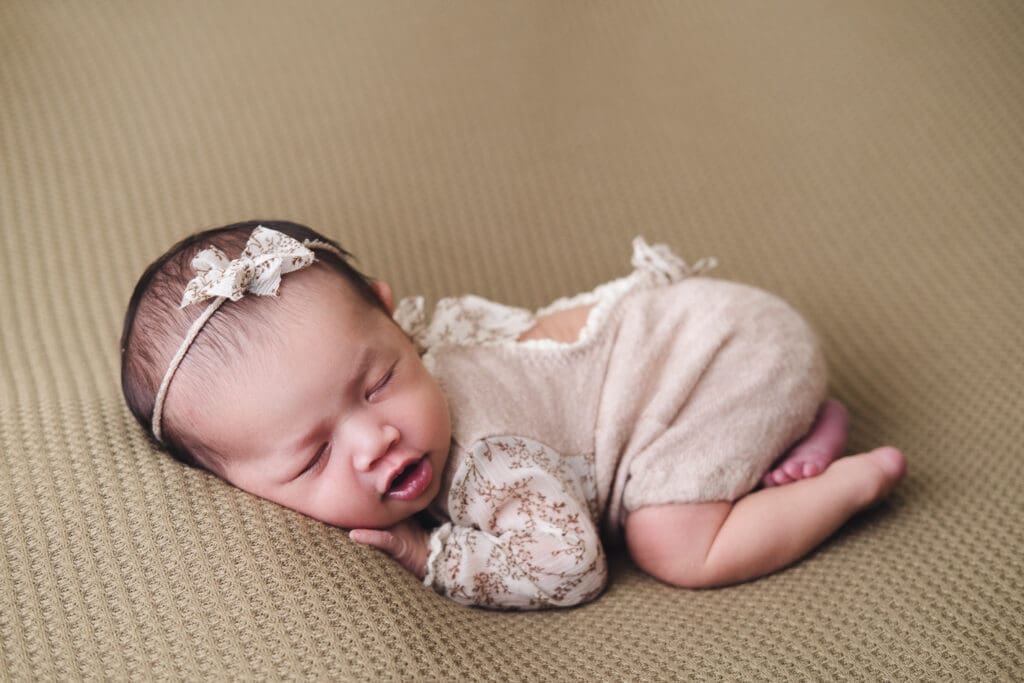
Sometimes the pose stays the same because the expression is worth capturing.
Same pose doesn’t mean a repetitive gallery
This is an important distinction.
If I photographed a baby from exactly the same position, with exactly the same framing and exactly the same expression ten times, you’d probably have a pretty repetitive gallery.
That’s not what I’m trying to do.
Instead, I’m looking for variety within the pose.
A full-body photograph gives you a sense of the entire baby and the setup.
A closer photograph brings attention to their face.
A detail shot might highlight their tiny fingers.
A wider frame might show more of the environment.
A different angle can change the relationship between the baby and the background.
And sometimes, keeping the composition similar is worthwhile simply because the baby’s expression has changed.
The result is a gallery that feels varied without needing to constantly change the baby’s position.
Making the most of every pose
For me, this is simply part of photographing a newborn.
I don’t want to think of a pose as:
Pose → one photograph → next pose.
I’d rather think:
Pose → explore → photograph → photograph → photograph → move on when I’ve got what I need.
How much I get from each pose depends on the baby, the pose itself and what I see through the camera.
Sometimes there are only a few good possibilities.
Sometimes there are many.
The important thing is to recognise them when they’re there.
A newborn session isn’t just about how many poses you can put a baby into. It’s also about what you can see within each pose.
And sometimes, getting the most out of a single pose simply means taking a few steps to the side, moving closer, stepping back and looking at the baby from a different perspective.
The pose may stay the same.
The photographs don’t have to.
Curious to see how this approach fits into a full newborn session?
Explore my newborn photography sessions and see how I approach each session at Meadow Lullabies.
VIEW NEWBORN PHOTOGRAPHY